
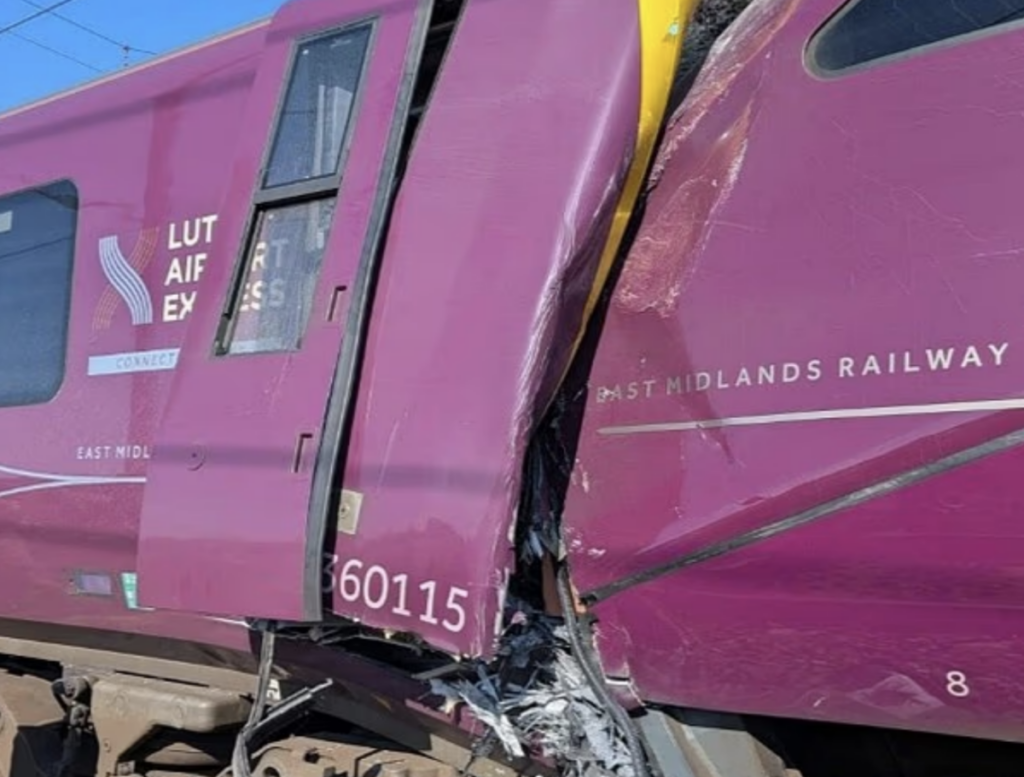
Rail accident investigators are examining whether signalling and train protection systems may have played a role in the devastating train collision near Bedford that left one driver dead and around 100 people injured.
The Rail Accident Investigation Branch (RAIB) has recovered the event data recorder, commonly known as the train’s “black box”, as part of its ongoing investigation into Friday’s crash involving two East Midlands Railway services near Kempston, south of Bedford.
While investigators have stressed it is too early to draw conclusions, multiple lines of inquiry are understood to be under examination as specialists work to establish how a moving passenger train was able to collide with the rear of a stationary service on one of Britain’s busiest main lines.
Signalling Protection Systems Under Scrutiny
One aspect reportedly being examined is whether the location where the stationary train came to a halt was fully protected by the railway’s Automatic Warning System (AWS) and Automatic Train Protection (ATP) safeguards.
Modern rail signalling is designed to prevent trains from entering occupied sections of track by displaying danger signals and providing warnings to drivers. Investigators will be analysing whether all protection systems operated as intended and whether the signalling sequence leading up to the collision functioned correctly.
Rail experts have already noted that under normal circumstances, signals should prevent a following train from entering an occupied block section.
Questions Over Breakdown Procedures
A second area of investigation is expected to focus on the actions taken after the leading train became stranded. Investigators will seek to establish whether the disabled train had fully cleared the signalling section and whether the track circuits and signalling equipment correctly detected the train’s position.
Part of the inquiry may examine whether the train remained within a protected signalling block, whether any faults affected track occupancy detection, and what information was available to signallers and train crews in the moments before the collision.
Specialists will also review communications between train crews, signalers and control centres as they reconstruct the sequence of events.
Black Box Data Critical
The recovery of the train’s event recorder is expected to provide crucial evidence, including speed data, braking inputs, signal aspects and other operational information recorded immediately before impact.
Investigators are also analysing signalling records, maintenance logs, onboard systems and witness accounts from passengers and railway staff.
The collision, which occurred at approximately 5.15pm on Friday, involved a Luton Airport Express service and a stationary passenger train. One train driver was killed, and dozens of passengers suffered injuries ranging from minor to critical.
Investigation Continues
The RAIB has emphasised that its investigation remains in the early stages and has urged against speculation while evidence is gathered.
A full safety investigation will seek to determine the immediate cause of the crash, any underlying contributing factors, and whether recommendations are required to improve railway safety and prevent a similar incident from occurring in the future.
Originally published by UKNIP.